



search
date/time

Sat, 10:00PM
overcast clouds
14.2°C
SSW 5mph
overcast clouds
14.2°C
SSW 5mph
 | Sunrise | 3:54AM |
| Sunset | 8:21PM |  |

Andrew Palmer
Group Editor
P.ublished 23rd May 2026
arts
Review
Classical Music: Look How Brightly Alex Mills – Chamber Music
The haunting, meditative world of a distinctive contemporary voice
Look How Brightly the Universe Shines!; Strings Attached; BARDO I; BARDO II; Release Me; I Love You; My Darkness; Scapegoat; Fragment; Dirge for the Living I; Dirge for the Living II; Dirge for the Living III; One Is Fun; The Body Keeps the Score
Chroma, Jess Dandy contralto.
Caroline Balding violin, Natalie Klouda violin, Kay Stephen Viola, Clare O'Connell cello, Roderick Chadwick piano, Steve Gibson & Rob Farrer percussion
Delphian DCD34355
https://www.delphianrecords.com/
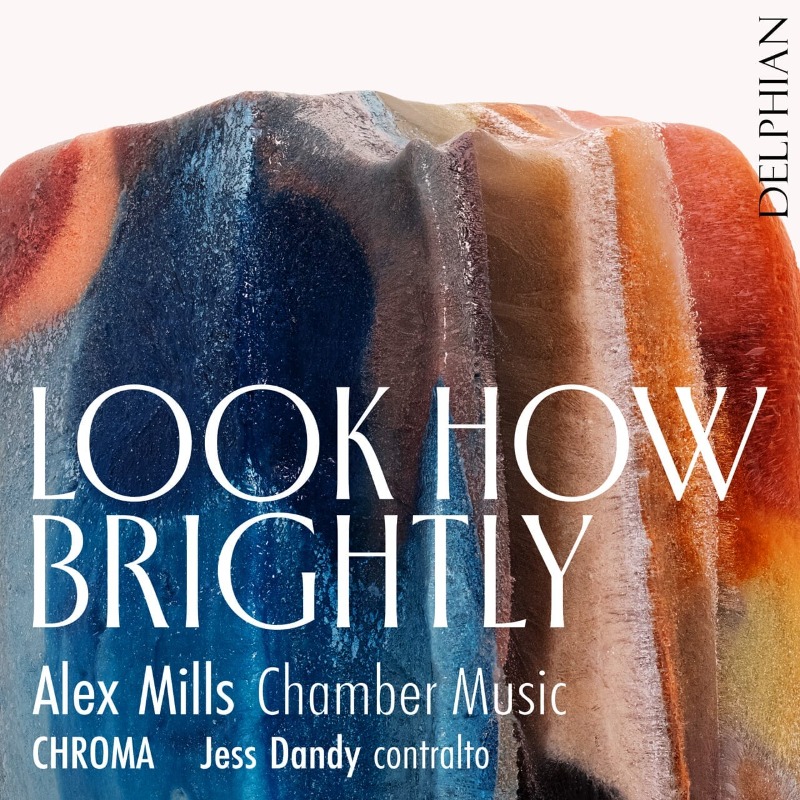
Across pieces for strings, voice, piano, percussion and tape – including three specially written for contralto Jess Dandy – familiar materials are quietly transformed. Patterns fracture and reform, stasis gives way to movement, and moments of unguarded lyricism emerge unexpectedly. Those encountering Mills for the first time will find a compelling introduction to a composer whose music asks not for interpretation but for attentive, inward listening—music, in Mills's own words, that is "not meditative but a meditation."
This is one of the great joys of contemporary music at its best: the capacity to suspend the listener in a charged, attentive present. The strings achieve something remarkable here, generating emotion through sheer concentration of texture. The intensity of Strings Attached is striking, and Mills's creative use of register, combined with carefully judged repetition, proves highly effective. Patterns circle and accrete; small shifts feel consequential.
Jess Dandy's contralto in Bardo 1 diffuses through the sound rather than sitting atop it, and the landscape Mills conjures is stark and elemental. Mills grew up in Pembrokeshire, and one hears that coastline in the music: the cliffs facing the Atlantic, the expanse of grey water, the particular quality of light over the sea. There is something, too, about how we might perceive colour in Mills's music— the way harmonic light shifts almost imperceptibly across a sustained surface.
Having recently reviewed Annabel Streets's The Walking Cure, in which she writes about the impact of walking on our wellbeing – touching on breathlessness, and in one chapter on how walking around cemeteries fosters relaxation, reflection and contemplation – I am struck by Mills's instinct for the closeness of the human voice to the strings. The two are not so much paired as woven into one another, each borrowing the other's breath.
The harmonics are particularly arresting, as is Mills's use of the piano, which is hypnotic in effect. The combination of percussion and tape in The Body Keeps the Score is especially haunting. Andrew Stewart's scholarly booklet notes are fascinating, supplying valuable background and context.
Each performer contributes plays of considerable beauty, and the balance across the disc is finely judged. In the brief I Love You, My Darkness, everything is held in exquisite control, with Dandy capturing the spirit of the piece with characteristic depth and sensitivity. The Body Keeps the Score lingers long after the final sound has faded – a fitting emblem for a release that rewards, indeed requires, the patient listener.