



search
date/time

Sat, 4:00AM
light rain
12.0°C
W 13mph
light rain
12.0°C
W 13mph
 | Sunrise | 6:29AM |
| Sunset | 5:26PM |  |

Andrew Palmer
Group Editor
P.ublished 10th October 2026
arts
Classical Music: Softest Thunder
Toby Carr finds the lute's quiet power
Poulenc: Sarabande (Arr. for Lute by Toby Carr); Robert Ballard II: Diverses Piesces Mises sur le Luth; Satie: Gnossiennes: No. 1, Lent; Gnossiennes: No. 2, Avec étonnement; Trois Gymnopédies: No. 1, Lent et douloureux (Arr. for Lute by Toby Carr); Johnson, R: The Prince’s Allmayne; Allmayne ‘Hit It and Take It’; Pavan; Batchelar: En me revenant; C Dowland: Suzanna Galliard (The Right Honourable the Lord Viscount Lisle, his Galliard);Tarleton's Riserrectione Purcell: The Virtuous Wife, Z. 611: No. 3, Slow Air (Arr. for Lute by Toby Carr); Laura Snowden: Blue Ballard, R: Premier Livre de Tablature de Luth: Ballet & Huitiesme Courante; Gaultier, E: Courante ‘Son Adieu’
Toby Carr
Delphian DCD34344
https://www.delphianrecords.com/
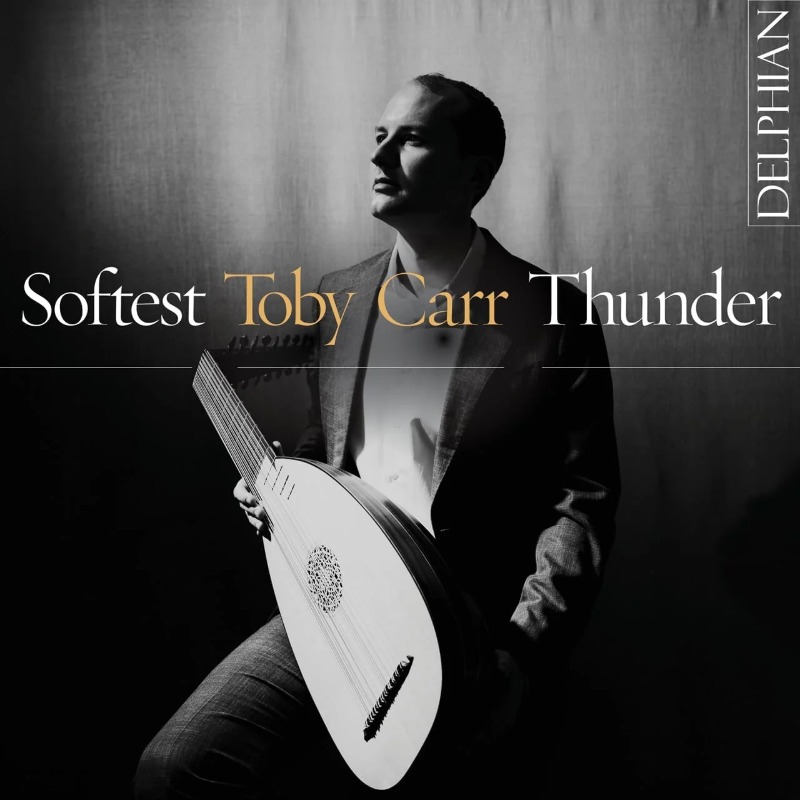
Carr will already be familiar to many from Battle Cry, his duo album with the mezzo-soprano Helen Charlston, which collected both Gramophone and BBC Music Magazine awards in 2023. Here he steps out alone, and the result is an atmospheric, quietly absorbing recital.
The opening track will catch out more than a few listeners. It sounds as though it has been plucked straight from a Jacobean manuscript, yet it is Poulenc's Sarabande, a work rooted in a dance form thought to have travelled to Europe from the New World. It is an inspired choice of curtain-raiser, setting the scene for everything that follows. Satie's Gnossiennes Nos 1 and 2 and the first Gymnopédie are equally at home on the lute; their spare, unhurried lines might almost have been conceived for it.
Carr makes a persuasive case for the composers who lived in Dowland's shadow. Robert Johnson, Daniel Bacheler and Philip Rosseter are scarcely household names. Carr readily admits that none of them could match Dowland's prolific consistency but argues that their finest pieces need fear no comparison. Johnson's Allmayne and the cheekily titled Hit it and Take it are two brief delights, and it is telling that Carr gives these lesser lights more room than Dowland himself, who is nonetheless represented by the charming Tarleton's Riserrectione.
At the heart of the programme sits Blue, commissioned by Carr from the guitarist and composer Laura Snowden. Written to sit among the older pieces, it fits like a glove. Snowden has clearly steeped herself in the courtly eloquence of the old lutenists, capturing their resonance and their spirit, and then speaks with an unmistakably present-day voice, drawing on techniques that would have baffled any Elizabethan player. The meeting of two eras is palpable, and the effect is quite mesmeric. Placing it halfway through the recital is a masterstroke: it becomes the hinge on which the whole disc turns.
Throughout, Carr's playing is a joy. Every piece has something to draw the ear in, whether a subtle shift of colour or a change of technique, and each track flows seamlessly into the next. Carr's instrument is something of a gentle giant: a ten-course Renaissance lute made by Jiří Čepelák in 2023. Its generous proportions pull the pitch down and lend the sound a deep, almost smoky warmth, and the recital has been built around precisely that character.
Carr's booklet essay is a thoughtful defence of an instrument many people know only from paintings. Its strings, slack and paired, give a sound that must be met halfway, and the best luthiers make the slender soundboard sing. Volume was never the point. Carr suggests that the lute's restraint is the source of its beauty, and that a quiet instrument holds up a mirror to a clamorous age. He describes a programme that grew gradually from long hours in the instrument's company, and his chief wish is simply that we savour what it can do.
The lute once reigned over European music-making, and an enormous body of music still lies waiting for the curious. I confess I have spent rather more of my life wrestling with organ stops than lute strings, and I came to this disc expecting a pleasant hour of background calm. I was wrong. This is ancient and modern in genuine partnership, and it shows the lute in an entirely new light.
Softest thunder indeed: it rumbles on long after the final note.
Also by Andrew Palmer...
Classical Music: The Beethoven Connection Volume 2Classical Music: Gershwin VariationsClassical Music: Sol Gabetta Saint-Saëns & Lalo Cello ConcertosClassical Music: Granville Bantock Orchestral WorksClassical Music: Ralph Vaughan Williams From Ursula, With LoveThe shortened address for this article is: newspub.uk/2217t