search
date/time
 | Cumbria Times A Voice of the Free Press |
1:00 AM 8th November 2025
frontpage
Nearly one third of Brits don’t know if they have a relative who served in WW1
Findmypast suggests that photographs of the fallen make families more likely to connect with their ancestry
Photo credit: diego_torres via Pixabay
Internal data analysis also reveals nearly half (45%) of soldiers who fought in the Army during WWI died childless, yet less than 14% of the nation has any awareness of these more distant great-uncles or cousins who made the ultimate sacrifice, leaving many of these men and their contributions lost to time entirely.
Findmypast has launched the growing Faces of the Fallen Collection, featuring over 3,500 photographs of soldiers who were killed, wounded, or went missing during the First World War.
Extracted for the first time from the pages of historical newspapers, they allow us to glimpse the faces behind the names etched on memorials across the UK. Throughout the Great War, thousands of photographs of soldiers were published in newspapers to commemorate local heroes – often covering full pages of print.
These images have been extracted for the first time and curated into a new searchable record set, available to access for free this Remembrance Weekend (7-9 November). It will help Brits uncover their personal connections to the Great War, preserving the stories and images of soldiers whose legacies may have faded over time.
57% of UK adults agree that they would feel more emotionally connected to a wartime ancestor if they had a photograph of them
Retired community relations manager, Gay Evans, uncovered nine relatives from the wartime generation who served, eight of whom lost their lives. One of those is her great-uncle Horace, who died aged 26, leaving a young widow and no children.
Through the Faces of the Fallen collection, she was able to find a rare photograph of him. “Uncovering a photograph I’d never seen of my great-uncle Horace was an emotional moment,” recalls Gay. “It made me tear up – he reminded me so much of my Dad. Researching my wartime ancestors is a way of remembering and honouring their wartime sacrifices: these beautiful young men who never came back and the family who were forever impacted by their loss.”
When considering the impact of historical images on family history research, over half (57%) of UK adults agree that they would feel more emotionally connected to a wartime ancestor if they had a photograph of them. A similar amount (54%) think photos would inspire them to learn about the broader historical context of their ancestors' lives.
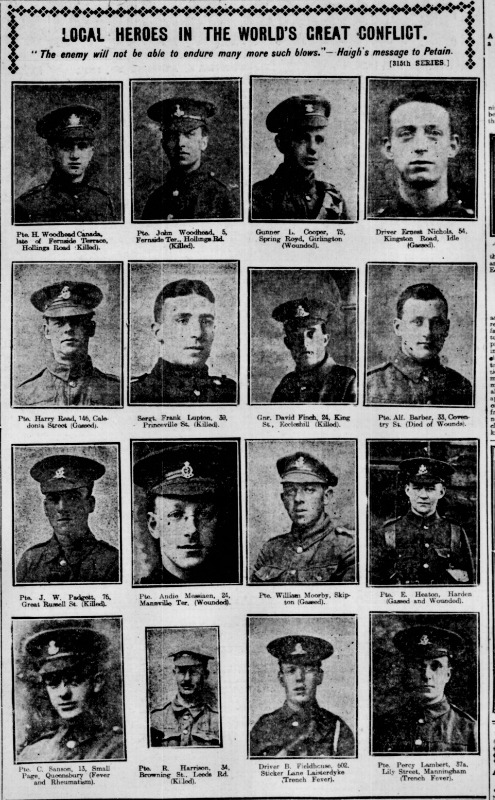
Bradford Daily Telegraph, 28th August, 1917. Courtesy of Findmypast
Findmypast is working with historian, author and presenter David Olusoga to encourage further exploration and understanding of these wartime heroes as an act of remembrance.
“This new data suggests that over time, the personal links that connect us to the people who lived, fought, and sacrificed in wartime slowly fade,” remarks Olusoga, commenting on the collection. “When a third of people no longer know their own family’s role in the First World War, we risk losing not just individual stories, but our understanding of the effects that the war had on the nation. It’s imperative that we continue to remember these lost family members by uncovering and understanding their experiences – and records and photographs are an ideal place to start.”