search
date/time
 | Cumbria Times Weekend Edition |

Andrew Palmer
Group Editor
P.ublished 10th January 2026
arts
Review
Classical Music: In Search Of Youkali - Songs Of Kurt Weill
Katie Bray's lustrous mezzo and exceptional collaborators chart the composer's restless journey through exile.
In Search of Youkali: Songs of Kurt Weill
A Glimpse of Youkali – An Improvisation; Barbara Song (from The Threepenny Opera); Berlin im Licht; Overture to The Threepenny Opera; Surabaya Johnny (from Happy End); A Vision of Youkali – An Improvisation; Complainte de la Seine (‘Beauties of the Night’ from The Torn Dress); Je ne t’aime pas; J’attends un navire (from Marie Galante); A Dream of Youkali – An Improvisation; Buddy on the Nightshift (from Lunchtime Follies); Nanna’s Lied; September Song (from Knickerbocker Holiday); Apple Jack (from Huckleberry Finn); A Premonition of Youkali – An Improvisation; Speak Low (from One Touch of Venus); My Ship (from Lady in the Dark); This Time Next Year (from Huckleberry Finn) Youkali.
Katie Bray (mezzo-soprano)
Murray Grainger (accordion), Marianne Schofield (double bass)
William Vann (piano)
Chandos CHAN20359
Chandos.net
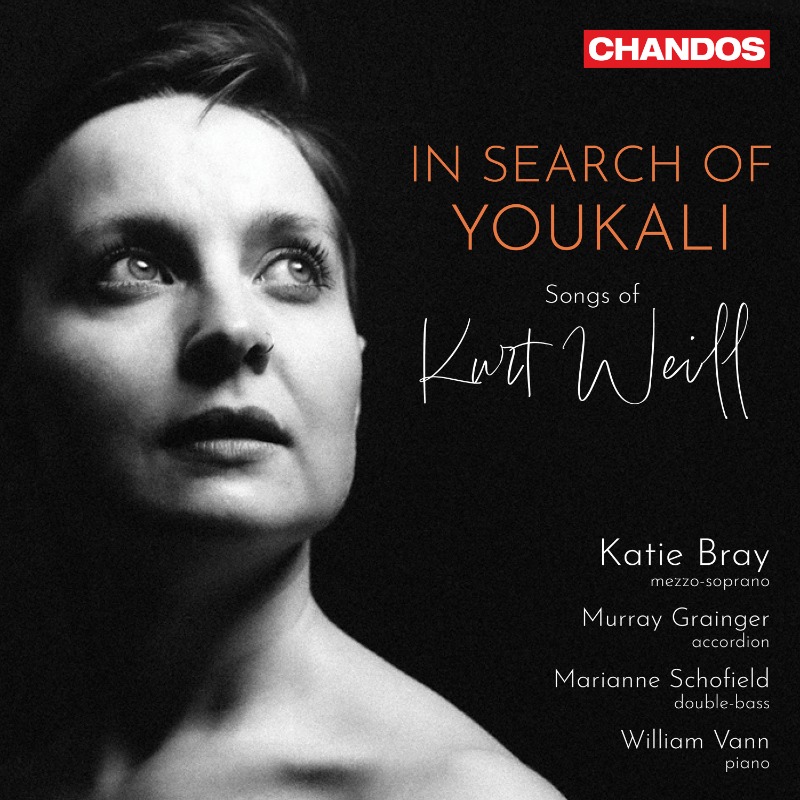
The disc takes its title from Weill's beguiling tango 'Youkali'—a song that has haunted Bray since her first encounter with the composer two decades ago. In her own words, she describes the work as "Weill's 'Somewhere Over the Rainbow'"—an expression of yearning for an impossible utopia that seems to mirror the composer's own peripatetic search for artistic and personal freedom following his exile from Nazi Germany in 1933.
Bray frames the recital as a journey through Weill's remarkable reinventions as he moved from country to country, each relocation bringing fresh musical metamorphoses. The mezzo-soprano finds particular poignancy in these songs' themes of displacement and the quest for belonging—sentiments that resonate powerfully in our own troubled times. Her programme, long in gestation and realised here with a close-knit team of collaborators, stands as both a tribute to Weill's chameleonic artistry and a meditation on the universal human search for sanctuary, compassion and peace.
From the opening track, it is immediately apparent how ideally suited Bray's voice is to Weill's music. Each performance is imbued with a unique richness and warmth that captures the composer's distinctive sensuality and burlesque irony.
William Vann's piano accompaniments prove wholly sympathetic, capturing Weill's spirit with exceptional sensitivity—nowhere more gorgeously than in his arrangement of September Song. The Overture to Die Dreigroschenoper, Bertolt Brecht's 1928 collaboration with Weill, receives characteristically idiomatic treatment with the addition to piano of Marianne Schofield on double bass and Murray Grainger on accordion. This quartet of performers brings out the individual character of each song with superb musicianship.
For lovers of this genre and devotees of Weill, this is essential listening. Full marks to the curation of this disc and to Bray's impeccable voice—a captivating release.